Welcome to Houston Astronomical Society

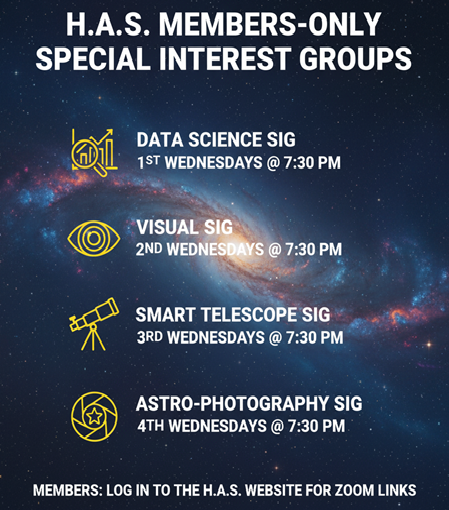
Fostering the science and art of astronomy through programs that serve our membership and the community. Founded in 1955, Houston Astronomical Society is an active community of enthusiastic amateur and professional astronomers with over 70 years of history in the Houston area. Through education and outreach, our programs promote science literacy and astronomy awareness. We meet via Zoom the first Friday of each month for the General Membership Meeting and the first Thursday of the month for the Novice Meeting. Membership has a variety of benefits, including access to a secure dark site west of Houston, special interest groups that focus on particular areas of astronomy, an active community outreach program, and much more. Joining is simple.

Sept 7th, 7pm HAS Novice Meeting, "Exploring Globular Clusters"

"Exploring Gobular Clusters"

by Justin McCollum


A person in a suit and glasses

Description automatically generated

Globular clusters are a natural congregation of stars born together in primeval clouds of Hydrogen and Helium in the early periods of the Universe. Globular clusters from the time of discovery in 1665 through the analysis of extragalactic globular clusters with the latest space telescopes constantly provide new information about the earliest ages of the Cosmos and the evolution of stars. Despite the latest results of scientific data and spectral insights into these fascinating structures, there are many unknowns and mysteries about globular clusters. The continuous discovery of globular clusters in the Milky Way galaxy is a hot field of astronomy even in the early 21st century.

This presentation will discuss the history of astronomical analysis of globular clusters, from their discovery to the latest information and theories about the nature of globular clusters. Tips and methods for observing globular clusters are a part of this discussion, combining photographic and spectrographic analysis to reveal the mysteries of globular clusters.

Our speaker: Justin graduated from Portland State University with an M.S. in Physics. Since 2005, he has been a Physics Laboratory Coordinator and departmental Astronomy instructor. His accomplishments include graduating at the top of his cohort in the postgraduate certification on Artificial Intelligence and Machine Learning with UT Austin McCombs School of Business in August 2023. Justin has also volunteered at the George Observatory since 2005 and has served in different club officer positions in several Houston area astronomy clubs.


This meeting will be held virtually via Zoom. In order to attend, you must register for the meeting. You can do so using the link below. You will receive a email with the details of the meeting and a link that will allow you to join in.

https://us02web.zoom.us/meeting/register/tZclcO-ppjIuHdZA4NbQrFLaswRd3VRplLg2

You only need to register once!

Join us Thursday, September 7th, 2023, at 7:00 pm CDST. See you then!

Sept 8th, 7pm HAS Meeting, "Light Pollution Effects on Human Health and the Environment”

" Light Pollution Effects on Human Health

 and the Environment”

A close-up of a person smiling

Description automatically generated

by Mario E. Motta, MD, FACC

Swayed by strong economic and climate-related arguments, many localities and businesses around the world are switching to LEDs for use in street and premises lighting. However, not all LED lighting is optimal.

LED fixtures which produce excess blue light are harmful to both human health and the environment. They interfere with circadian rhythms and reduce melatonin production which can lead to suppression of the human immune system.  There is now voluminous data showing a higher risk of hormonally linked cancers with melatonin suppression. Excess blue light also can have negative effects on plants and wildlife.

Lighting fixtures that are overly bright, improperly designed or installed can create glare. Overly blue-colored light makes the glare worse, since blue light scatters more in the human eye.  This leads to increased disability glare which has serious implications for night-time driving visibility and can hide pedestrians or other conditions from a driver’s view.

Dr. Motta will present research data on the harmful effects of excess light at night on both human health and safety, and adverse effects on wildlife and the environment.

Our Speaker: Dr. Motta has long been active in organized medicine, both in the American Medical Association (AMA) and in the Massachusetts Medical Society (MMS), holding a number of posts through the years. He is a Past President of the MMS and was elected to the AMA Council of Science and Public Health where he has served eight years and elected to the Board of Trustees of the AMA in 2018, recently completing his term.

He has also served on the Board of the International Dark-Sky Association. He has worked on light pollution issues and published several white papers on light pollution as a member of the AMA Council of Science and Public Health. He served on a UN committee (COPUOS) representing the AMA on light pollution for a worldwide effort to control light pollution and satellite proliferation.

Dr. Motta had been in practice at North Shore Medical Center in Salem, Massachusetts, since 1983, recently retiring in 2022. He is a graduate of Boston College, with a BS in physics and biology, and of Tufts Medical School. He is boarded in and is a fellow of the American College of Cardiology and of the American Society of Nuclear Cardiology.  He is an associate professor of medicine at Tufts University School of Medicine.

Dr. Motta also has a lifelong interest in astronomy, and has hand built a number of telescopes and observatories through the years to do astronomy research, including his entirely homemade 32-inch F6 relay telescope located in Gloucester, MA.  He has been awarded several national awards in astronomy, including the Las Cumbras award from the Astronomical Society of the Pacific in 2003, and also the Walter Scott Houston award from the northeast section of the Astronomical League, and in 2017 the Henry Olcott Award from the American Association of Variable Star Observers (AAVSO).  He has also served as a president of the ATMs of Boston and has served as a council member of the AAVSO, and is a past president as well.

Finally, several years ago the International Astronomical Union awarded Dr. Motta an asteroid in part for his work on light pollution as well as amateur research, asteroid 133537MarioMotta.

---------------------------------------------------------------------------------------------------------------------

This meeting will be held virtually via Zoom. To attend, you must register for the meeting. You can do so using the link below. You will receive an email with the details of the meeting and a link that will allow you to join in.

https://us02web.zoom.us/meeting/register/tZYsduqurj8rGNQ10L8J44DrIV1wL_lOYc8j

You only need to register once!

Join us Friday, September 8th, 2023, at 7:00 pm CDST.

See you then!

C14 refresher for trained telescope operators, Aug 5, 6

If it's been a while since you've taken observatory building training, I will be in the observatory Saturday and Sunday nights, Aug 5 and Aug 6. Use this time to build back "muscle memory" on operating the C14. I'll have a new telescope operator's guide for you to use and can answer your questions. Email [email protected] so I can verify your previous training. 

Saturday night, mostly clear. Astro dark from 21:49 to 23:20. Sunset 20:23; moonrise 23:20.

Sunday night, mostly clear. Astro dark from 21:48 to 23:52. Sunset 20:22; moonrise 23:52.

"Observing Saturn and Jupiter at Opposition"

by Chris Morisette


A person standing in front of a snowy mountain

Description automatically generated

Over the next several weeks, two of the night sky’s “greatest hits” will move in the sky until they are best placed for observation. On August 27th, Saturn will reach opposition, followed by Jupiter at opposition on November 2nd.

At opposition, the Earth will be directly between the Sun and the planet. It is an alignment which, from our perspective, has the planet exactly opposite from the Sun on the sky. When the sun is setting, the planet is rising, with the opposite occurring at sunrise.

Novice Chairperson Chris Morisette will describe this alignment of the planets and explain how to take advantage of this favorable alignment to observe them. He will also give us some tips for making your observations, and what you should expect to see as these planetary “rock” stars (gas giants – no rocks really) present themselves for our close inspection.

Our speaker:

Chris Morisette is HAS Novice Chairperson and an active member of the Houston Astronomical Society, North Houston Astronomy Club, and the Fort Bend Astronomy Clubs.  He is also a member of the University of Texas Astronomy Department Board of Visitors.  On clear Saturday nights you may find him volunteering at the George Observatory engaging with visitor and sharing his love of the night with them, while totally having fun operating the telescopes there, or you may find him at the HAS dark site gaining experience with astrophotography.


This meeting will be held virtually via Zoom. In order to attend, you must register for the meeting. You can do so using the link below. You will receive a email with the details of the meeting and a link that will allow you to join in.

https://us02web.zoom.us/meeting/register/tZEqcu2hqzsjGNJNVnFX_0ECpZhfzHUdiz9C 

You only need to register once!

Join us Thursday, August 3rd, 2023 at 7:00 pm CDST. See you then!


"The Cosmic Creation of the Elements"

by Bill Spizzirri

William Spizzirri

At the very beginning of the universe, in the burst of energy called the big bang,  there were no atoms. Today, everything we see, all the stars in all the galaxies, all the planets, everything in our solar system, everything on earth, even every part of our own bodies are made of atoms - 114 chemical elements. Together, we will embark on a voyage of discovery, to uncover how all the elements were created and how they came to be in our bodies today.

Our Speaker: Bill Spizzirri is a retired computer software engineer who has been studying astronomy for over 65 years. His favorite thing to do is to teach astronomy to the public, especially children. He has been doing that more or less continuously for over 40 years. He now does it at Houston area schools and community centers. The pay is excellent, in the form of great questions from the students.

---------------------------------------------------------------------------------------------------------------------

This meeting will be held virtually via Zoom. To attend, you must register for the meeting. You can do so using the link below. You will receive an email with the details of the meeting and a link that will allow you to join in.

https://us02web.zoom.us/meeting/register/tZ0tdO-qrjgjHdxddePMOlei8OSv5ZARHC_5 

You only need to register once!

Join us Friday, August 4th, 2023 at 7:00 pm CDST. See you then!